How do I not be gay? The question wouldn’t stop pounding inside Kaleb Emery’s head as he punched it into the Google search bar on his Ipod Touch. At age thirteen, he began searching the Internet for answers about a label he didn’t yet understand. But he did know this: he was attracted to guys and in the religious household he was raised in that was not okay. Kaleb, now 20, said this was the lowest point in his life. He was in seventh grade when he realized he was attracted to boys and immediately sensed it was a problem that needed to be cured.
The idea that homosexuality is wrong has seen a huge shift between generations. According to a poll conducted by Pew Research Center, 70 percent of Generation Y supports same-sex relationships while only 35 to 49 percent of older generations do. Kaleb saw this lack of acceptance in his own household and hometown. Fearing he would lose friends and hurt his reputation in the conservative town, Kaleb didn’t come out as gay until he reached college. “I didn’t come from a terrible town, but it was a town very set in its traditional values. It was just very socially conservative and family-oriented,” he said.
Two weeks after starting college, Kaleb received a call from one of his hometown friends. He had only told a few friends from home about coming out, but word of his sexuality began spreading without his permission. “I was ready to come out but at the same time it wasn’t their right to tell that for me,” Kaleb said. “I wasn’t as mad as I would have been if I had been younger but I still was upset.” Kaleb’s biggest fear at that moment was that it would get back to his parents before he could tell them himself. “I just wanted to be the one to tell them, no one else,” he said.
Kaleb’s parents were surprised, but he also thinks they were just in denial. Since learning their son’s sexuality, Kaleb thinks they still don’t understand that it’s a huge part of his identity.
“I was just raised very religiously. It was hard for them to wrap their head[s] around, and it still is,” he said. “My dad especially isn’t necessarily in full support of my sexuality. My mom is curious about my love life but because it is not a love life she is used to she doesn’t really know how to go about it.”
Kaleb said it makes for an awkward conversation, because their generation doesn’t know how to deal with those kinds of questions.
As for his grandparents, Kaleb doesn’t plan on ever telling them. “They practice their religion more closely than my parents do. I’ve even heard some homophobic things from my grandma,” he said.
He says he’s not himself with his family. This disconnection between his family about not truly understanding a big part of who he is has helped him seek supportive relationships within his friend group.
“Being gay has helped me as a person because it has taught me how to surround myself with people who are comfortable with all aspects of me. I’m just very fortunate to have grown up in a generation that was able to have media access to these subgroups so that they do understand,” he said.
Kaleb notes that when he was younger an LGBT presence on social media helped him understand what it meant to be gay. “Social media has worked wonders for the gay community. The first step is coming to terms that being gay is a real thing. [Social media] got it out there.” Access to online stories and support gave him positive insight into his sexual orientation.
An increased LGBT community presence through television shows, social media, and news outlets is also what Kaleb believes separates the Millennial generation from older ones. “It humanizes the LGBT community because they can play characters on sitcoms. It makes people understand that this community is a part of us,” Kaleb said.
Kiersten Baughman, a professor in psychological science at Ball State, says the empathy we see within the Millennial generation is the product of a cultural shift in values. “Specifically, it’s a culture value that’s causing the country to become more politically liberal,” she said. This change in political views initiates a push for diversity. Like Kaleb mentioned, Kiersten says that forcing individuals to be exposed to diverse views creates tolerance and acceptance. “When culture transitions occur it takes a long time; we will continue to see these transitions in future children,” she said. Kiersten said the biggest reason for the delay period in normalizing new values is that people are averse to change.
Recent research reflects this shift in values. Statistics show that social change is accelerating among the Millennial generation, as they are more accepting of things that were previously considered taboo. According to Pew Research Center, the acceptance of same-sex relationships has changed over the past 15 years.
A 2001 poll conducted by the Pew Research Center showed that Americans opposed same-sex marriage by 57 percent while 35 percent were in favor. The results indicate that not long ago a majority of Americans disapproved the idea of homosexuality. A similar poll taken by the same group in 2015 indicates that Americans support same-sex marriage 55 percent with 39 percent still in disagreement. In just 14 years, Americans have become more supportive of homosexuality being a part of society.
Madison Egold knows the same familial tension, but a different kind of prejudice: one not based on similarity of gender, but a difference of color. She discovered that her interracial relationship, once considered taboo, was still unacceptable to the ones closest to her.

Madison, 19, a child life and sign language major, met her current boyfriend, Allain Duncan, 21, through mutual friends. They instantly felt an attraction to each other. On the night before Allain came over to meet Madison’s parents, they told Madison how excited they were that she had someone in her life she cared enough about to introduce to them.
“Alright so this is pretty serious?” Madison’s mother asked her. “I mean you want us to meet him.” Madison’s mother didn’t give any signs that she was uncomfortable with her daughter going on a date with Allain.
“They asked how old he was, so they had always known he was older, that wouldn’t have been a problem,” Madison said. “It wasn’t anything new for me to be dating someone either.”
As soon as Allain came in the doors, Madison sensed her parents’ mood had changed.
The family played cards and talked with Allain until it was time for Madison and Allain to leave on their date. Allain was no longer just a friend in the household, but rather the man with whom their daughter would be alone in a romantic setting.
Before the couple left for their date, Madison’s parents pulled her into the garage.
“You’re not leaving with him,” they said.
“What?”
“You’re not leaving with him!”
Madison couldn’t understand the turn in their behavior and why it suddenly wasn’t okay.
“I just don’t feel comfortable, he’s a lot older,” her parents said, but Madison said she knew it had to be Allain’s race that brought out this irrational fear of her going out with him.
“They already knew his age,” she said. “They had just seen the color of his skin.”
Madison’s parents eventually let them go on their date but with the stipulation that her father would be making sure they got to their destination safely. “He wouldn’t have done that if Allain [wasn’t] black,” she said.
After an awkward first date, Madison and Allain continued to date without telling her parents the true nature of their relationship. He visited her at her track meets and her home, but to her parents, they were just friends. Once, when Madison asked her mom if she was comfortable with them being a couple, her mom told her that she didn’t want Madison to date him.
“It was awful, especially because I already had been dating him. That’s why I didn’t want to tell them in the first place. After the garage incident I knew how they would react,” Madison said.
While her parents have voiced their opposition, other people in the couple’s life have been nothing but supportive of their relationship. All of Madison’s friends hang out with the two of them, and her older sisters and their husbands often invite them for dinner.
Research shows that this is the case for most of the Millennial generation. According to Pew Research Center, when Millennials were asked about a family member’s marriage to a different race, nine in ten wouldn’t be bothered by their marriage to an African American (88%), a Hispanic American (91%) an Asian American (93%) or a white American (92%).
The same report states that only 52 percent of white Americans between 50 and 64 would be okay with a family member dating someone of another race. For Madison’s parents, she thinks it came down to how they thought it would reflect on her reputation.
“Honestly, I just think my mom was worried about my image. [It] sounds so terrible but it was a conservative town and I don’t think that she wanted that, or me, to be associated with something that the small town could talk about,” Madison said.
After realizing her parents would never let her date someone of a different race, whether for their own reasons or the possible backlash of a small town, Madison chose not to listen. Her parents still do not know that she has been in a relationship with Allain for more than two years.
“So many nights I would just tell him ‘I don’t want to lie to them anymore,’” Madison said. She will try to tell her parents about her and Allain this Thanksgiving, but said whether they approve still won’t matter.
Allain was understanding of Madison’s parents’ reaction toward the idea of her dating him. “Honestly, at first it didn’t bother me very much. It doesn’t make me angry. I just can’t believe people still think like that,” he said.
For older generations, conforming to conservative norms seems to hold greater importance than it does for their children. Kaleb and Madison both experienced concern from their families about public image, but the need to conform doesn’t translate in the same way for Millennials. The desire for true personal expression trumps the desire to assimilate.
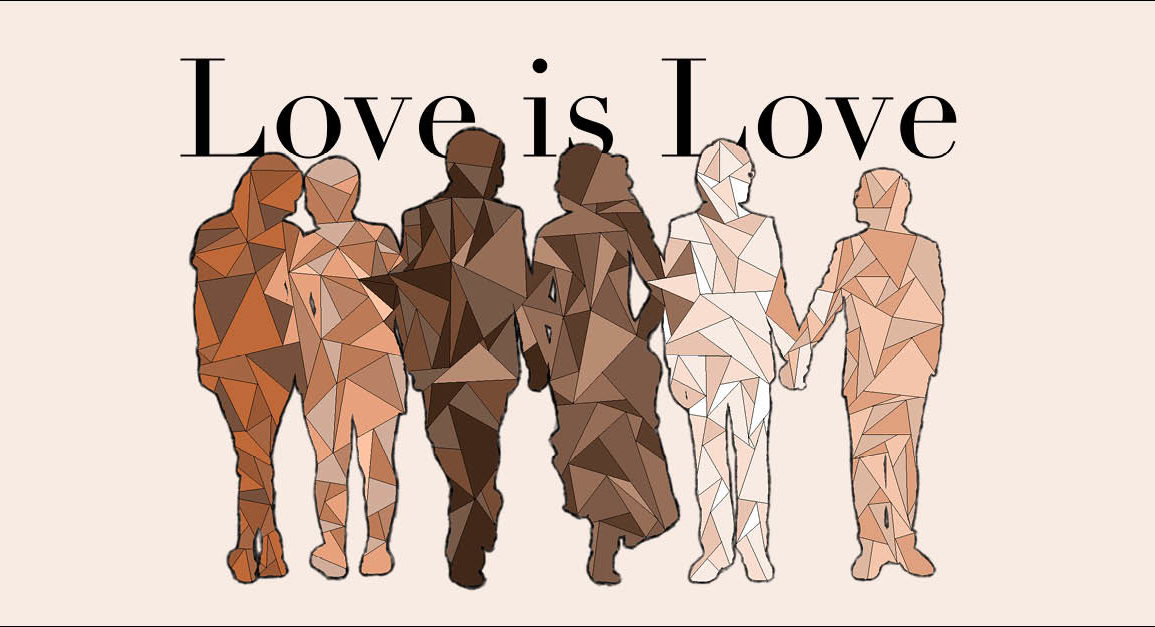
Millennials are redefining social acceptance of all forms of love. Through the innovation of social media, young people advocate for diversity and educate their peers about different kinds of relationships and diverse cultural viewpoints.
“At this point,” Madison said, “I just think that love conquers all. You have to let the rest go.”