

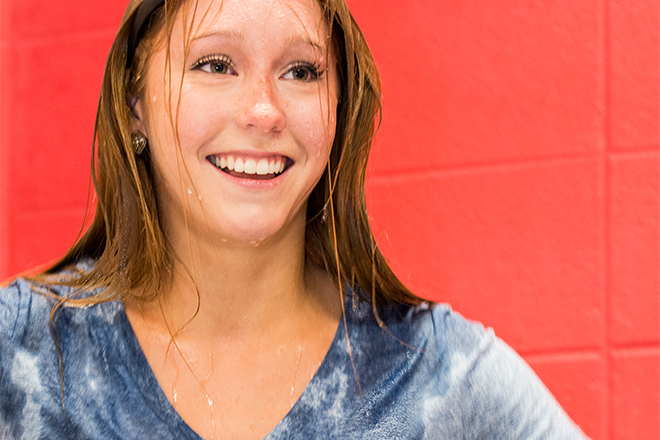
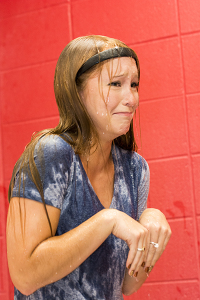
Brooklyn Schumacher is one of millions across the world to have completed the ALS ice bucket challenge. It was created in order to raise awareness for Amyotrophic Lateral Sclerosis. According to the ALS website, the publicity from the challenge has brought awareness to the disease and has raised $108.4 million as of Sept. 4, 2014. Brooklyn Schumacher is one of millions across the world to have completed the ALS ice bucket challenge. It was created in order to raise awareness for Amyotrophic Lateral Sclerosis.
Brooklyn Schumacher is one of millions across the world to have completed the ALS ice bucket challenge. It was created in order to raise awareness for Amyotrophic Lateral Sclerosis. According to the ALS website, the publicity from the challenge has brought awareness to the disease and has raised $108.4 million as of Sept. 4, 2014.

Whether you’re Michael Jordan, Justin Beiber or even former President George W. Bush, no one is exempt from a nomination for the ALS Ice Bucket Challenge.

For the past few weeks, it has overtaken our Instagram and Facebook pages. Most videos are the same: they thank the person who nominated he or she, challenge a few others and finally, get dowsed by a bucket of ice water.

[two_fifth]

When I received two nominations in the same day, I started to question the whole craze. I couldn’t have told you what ALS stands for and I really didn’t understand why dumping a bucket of water on myself brought any awareness to the disease.

Before my 24 hours were up, I looked into the meaning behind the challenge. Amyotrophic lateral sclerosis, also known as Lou Gehrig’s Disease, is a progressive neurodegenerative disease that affects nerve cells in the brain and the spinal cord.

As the disease takes over the body, motor neurons die, and the brain can no longer control muscles. Total paralysis is certain, and generally occurs within 2-5 years of diagnosis.

The challenge benefits the ALS Association, which helps provide care services to people with ALS and their families.

Their global research program focuses on the discovery of treatments and eventually a cure for the disease.

When I took the challenge, I dedicated my experience and donation to an old friend whose father died two years ago after four years of fighting.

Ball State alumni Matthew Amaro has a unique perspective on the Ice Bucket Challenge. Two years ago, his brother, Robert, died of ALS at 49 years old. He went to the doctor after falling numerous times due to muscle failure and was diagnosed in February 2012.

Robert became dependent on an electronic wheelchair and his 24-hour nurse four months later. Because there is no cure for ALS and very little treatment. Robert died September of the same year after going into cardiac arrest.

After watching one of his role models lose his freedom and life to ALS, Matthew sees the ice bucket challenge as a positive trend.

“People are actually hearing and talking about it…I would talk to people about my brother dying from ALS and more often than not had to explain what it was,” Matthew says.
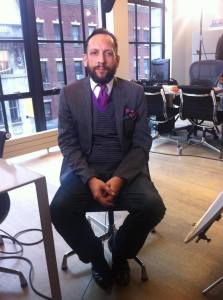
Robert Amaro interviewed for a documentary in October 2011, a year before he died.

He acknowledges that the challenge has lost some of its meaning by people participating just to avoid making a donation. However, he chooses to give everyone the benefit of the doubt.

“Just because someone didn’t choose to make it known that they were donating doesn’t mean they didn’t,” Matthew said.

When Matthew took the challenge, he dedicated the experience to his late brother.
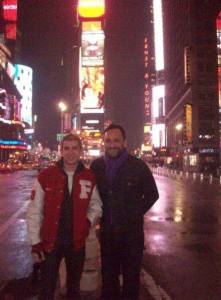
Matthew Amaro and Robert Amaro visited Times Square in April 2009.

This trend began with Chris Kennedy in Sarasota, Florida. He was nominated by a friend to take part in this challenge and donate to any charity. He used the opportunity as a platform to give to Lou Gehrig’s disease research in honor of his cousin. Nominations continued until it reached Pete Frates, a former Boston college baseball player who also has ALS. He is credited with the founding of the craze because he nominated Tom Brady, which caused the trend to pickup speed.

Matthew says the point of pouring ice water on yourself is to mimic the feeling of what a person with ALS experiences daily: not extreme cold, but the loss of control of your own muscles while still feeling everything.

The ALS Association reports that they have received $107.4 million in donations this year compared to almost $3 million during the same time period last year, which is just over 30 days. Since this challenge hit social media, the association gained 3 million new donors. While that’s only a small portion of people partaking in the challenge, the numbers are rising exponentially by the week.

“Even though my brother died from this horrible disease, at least many others who will be diagnosed with have a chance,” Matthew says. “And while there is treatment that can slow down progression, there is a quality of life aspect that you have to dwell on as well. We’re looking for a cure.”
  1. Last year, my 68-year-old partner was diagnosed with Lou Gehrig’s disease also known as ALS. Speaking and swallowing were two of his challenges. His collapse was swift and catastrophic, and neither the riluzole nor the medical staff did much to aid him. He would not have survived if our primary care physician hadn’t given him attentive care and attention, as the hospital center didn’t provide any psychological support. His fall was abrupt and catastrophic. His hands and legs gave way to weakness in his arms. This year our family physician suggested using natural herbs centre m for ALS/MND treatment, which my husband has been receiving for a few months now. I’m delighted to say that the treatment greatly reduced and reversed his symptoms of ALS, he no longer requires a feeding tube, sleeps soundly, works out frequently, and is now very active. In the hopes that it could be useful, I thought I would relate my husband’s tale; in the end, you have to do what suits you the best.

  2. After my husband Lou Gehrig’s disease diagnosis, our primary care provider introduced us to Uine Health Centre and their ALS/MND Formula protocol, the ALS/MND treatment has made a tremendous difference for my husband. His symptoms including numbness and muscle weakness all disappeared after the treatment plan!

  3. My first ALS symptom occurred in 2016, but was diagnosed in 2018. I had severe symptoms ranging from shortness of breath, balance problems, couldn’t walk without a walker or a power chair, i had difficulty swallowing and fatiue. I was given medications which helped but only for a short burst of time, then I decided to try alternative measures and began on ALS Formula treatment from Aknni herbs centre, It has made a tremendous difference for me (Visit ww w. aknniherbscentre.c om). I had improved walking balance, increased appetite, muscle strength, improved eyesight and others.

  4. I was diagnosed with bulbar ALS in May 2024. I live in Texas, and I’m 68 years old. I take Nudexta medication to help with the emotional outbursts of laughing and crying. The weakness, slurred speech, and muscle loss progressed quickly. Mobility has been an issue since Dec 26, when I fell and broke my hip, and although I made small strides at first, I felt like my life had been placed on a countdown, as there was no known cure other than the prescription of riluzole medications, vitamins, and therapies. As the disease progressed, my symptoms worsened. With my neurologist’s guidance we decided to try other approaches and started the ALS/MND treatment, and it changed everything. Within 5 months, I noticed more strength in my limbs, clearer speech, and I have stopped using feeding tubes. I’m starting to learn how to walk again & I now sleep better. This ALS/MND treatment program gave me back control and hope. Visit their website www. Uine health centre . Thanks to nature, I can feel my strength again.

  5. I was diagnosed with bulbar ALS in May 2024. I was wheelchair bound. My feet hurt horribly on the foot petals. I started ALS/MND programme about 4 months ago. I’m now able to walk down the street and back at least I couldn’t do that prior to the ALS treatment. It doesn’t make the ALS go away but it did give me better quality of life. I got the treatment from Uine healthcentre .n et

Your email address will not be published. Required fields are marked *