Editor’s note: This article reflects on the life and influence of Grace DeHority based on archival information and the writer’s reflections. His views do not necessarily reflect those of Ball Bearings Magazine.
“Fill all blanks, please.”
Such was Grace DeHority’s “favorite saying,” according to the 1923 edition of the Ball State Orient, the official university yearbook, which is no longer in production. This line reads less as a pleasant instruction at an appointment you’d rather skip, but rather as a challenge raised to every student.
Grace was a testament to the fact that one’s legacy can never truly be measured by the power of their name alone.
An editorial published in the Muncie Evening Press after her death declared, “Here was a woman of staunch character, a living example of the ideals that were always her guiding stars, a good woman. She set a high standard for herself and continually urged others, particularly the women who came under her, to live full lives.”
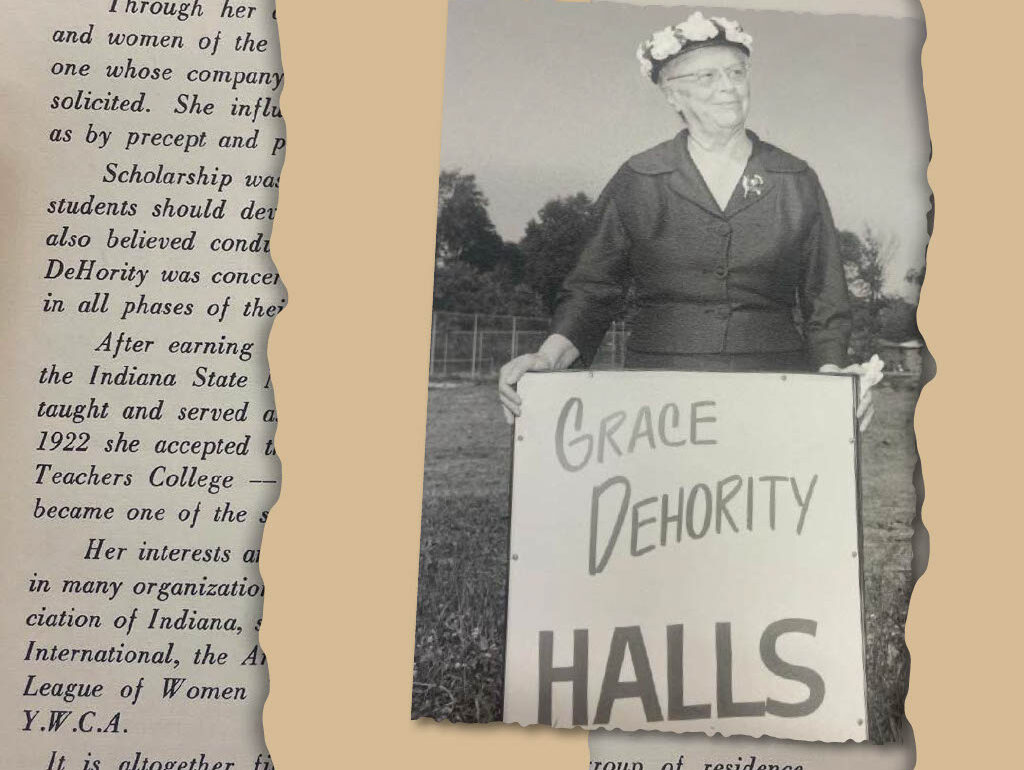
Grace’s legacy is more than just the dormitory complex where students occupied their freshman year; her legacy lies within the thousands of women who were under Grace’s tutelage during her 24 years as Dean of Women.
On Aug. 2, 1879, Grace DeHority became one of fewer than 800 in the quaint town of Elwood, Indiana. Born to James and Louisa DeHority, she lived in a house of eight. Grace was the eldest of her siblings. Throughout her early years, Grace matriculated through the Elwood public school system, graduating at age 19 in the summer of 1899.
Right after graduation, she began teaching at Elwood schools, earning a $360 annual salary to start. Grace taught at Elwood Elementary for ten years until 1910, when she moved to the junior high. It was here that she taught science and geography, improving her earnings to a $1,100 annual salary. However, in 1907, at the age of 28, Grace DeHority’s life as a teacher became far more complicated.
Her father, a small grain and implement dealer, passed away just one year after her mother. This left her to raise her youngest sibling, twelve-year-old Anna, on her own.
Her sisters, Ethel and Alice, were married off, and her brothers Glen and Chester went off to find their own wives soon after.
It was only after Anna’s coming of age, six years following their father’s death, that Grace found the time to attend the Indiana State Normal School in Terre Haute, earning a bachelor’s degree in philosophy in 1920, at age 41.
After graduation, Grace found herself as the principal of her alma mater, the junior high school in Elwood. She only occupied this position for two years, as in 1922, she took the vacant position formerly filled by May Klipple: Dean of Women at Ball Teachers College. The position had only existed for four years, beginning in 1918, with Viletta Baker operating as the first Dean of Women until 1921, when May took over for a year.
Viletta and May, who went on to become professors of foreign languages and English, respectively, each had a hall named after them; these halls would complete what would become the Noyer Complex, a dormitory that still stands today.
In 1946, when Grace retired after 24 years at Ball Teachers College, the position retired with her. No longer would there be a Dean of Women and a Dean of Men.
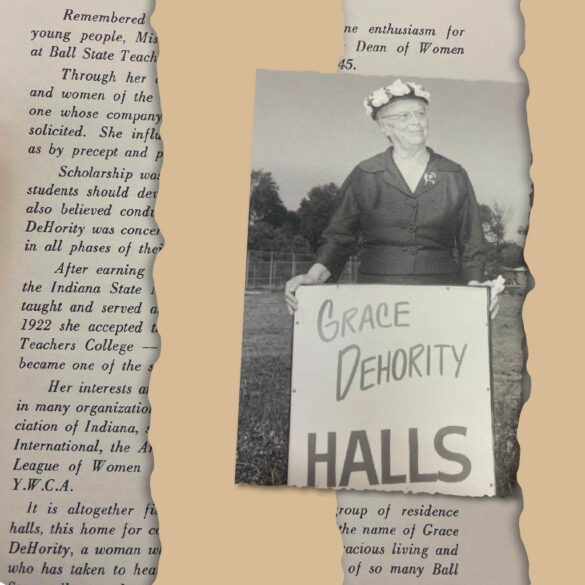
After World War II, when soldiers came back from war and resumed their education, students would be under one dean, regardless of gender. In the years following her retirement, the Ball Teachers College community made Grace’s name a hallowed one. Fourteen years after her retirement, in 1960, Grace’s work at the university was honored with a brand new dormitory in her name: the Grace DeHority Residence Hall.
In interviews published in the Muncie Evening Press, students spoke of the impact Grace had on their lives. A former student said of Grace,
“When I think of all I got from her in college, I don’t know how any woman could give so much. She expected good conduct and even insisted on it; yet, she was kind but firm when people did not live up to [her] high standards.”
Grace’s colleagues in the student personnel department at Ball Teachers College praised her dedication deeply, detailing in a statement in the Muncie Evening Press: “Through her desire to understand and help the young men and women of the college, Miss DeHority became their friend – one whose company was enjoyable and whose counsel was often solicited. She influenced conduct and aims by example as well as by precept and program.”
Between fulfilling her duties as dean, she found the time to earn her master’s degree at Columbia University, which she completed in 1928.
As Dean of Women, Grace held the advancement of women’s rights as top priority. In her time, Grace was one of the most active members of the local feminist community, supporting young women in embracing their independence and their power all throughout her time in Muncie.
At Ball State, she sponsored several sororities, while also taking on the Girls’ Club, founded by her predecessor, Viletta Baker. By her final year at Ball State in 1946, she had grown the Girls’ Club to be the largest organization on campus, with over 500 girls being members of the club.
In the spring of 1945, as most young men in the country were still overseas, there were only 550 students at Ball State. Nearly every single student at Ball State was female at the time, and nearly every single Ball State student belonged to Grace DeHority’s Girls’ Club.
The president of Ball State from 1945-1968, John Emens, once said, “Ball State is what it is today because of a loyal, hard-working and dedicated faculty who had faith in a young institution. Miss DeHority was one of the leading members of this rather small, but stellar group.”
Grace didn’t stop there; she also had a deep involvement with the Central Indiana chapter of the Young Women’s Christian Association (YWCA), heading a leadership committee of 18 girls, serving as president of the organization and later as the president of the board of directors. She was also the head sponsor of a Ball State chapter of the YWCA, heading a leadership committee of 18 girls, with a president, vice president, secretary, treasurer, and a cabinet consisting of 14 female students.
The Ball State YWCA would host a variety of events, including its Morning Prayer with and its World Student Service Fund. What gained Grace the most notoriety within the Muncie community, however, was her involvement in the Altrusa Club. Now, Altrusa International of Muncie, Indiana, the Muncie division was founded on Oct. 17, 1923, with Grace present as a founding member.
From 1923 until she died in 1964, she was an extremely active member of the club, often using the home she shared with Ms. Barcus Tichenor, Ball State librarian from 1921 to 1945, as a home base for Altrusa Club meetings.
On the morning of June 19, 1964, Grace was seen picking flowers from her garden hours before that night’s annual meeting. That afternoon, she fell ill and was rushed to Ball Memorial Hospital, where she died shortly after. The Altrusa Club annual meeting on June 19 occurred without a single flower from the DeHority garden.
The people of Muncie refused to see another Altrusa Club meeting without the presence of Grace’s flowers. In 1965, her YWCA colleagues used funds raised from the YW Thrift Shop, which she had personally supervised, to build the Grace DeHority Memorial Garden, located on the east side of the Muncie YWCA.
“Miss DeHority served graciously and with dignity and a deep appreciation of all with whom she came in contact. She leaves us a rich legacy for which we are all grateful,” John said of Grace in a statement published after her death in the Muncie Evening Press.
In an article published in the Muncie Evening Press by Marjorie Parsons, she was described as a “campus oracle.”
In Grace’s eyes, when asked what she believed her job was, she believed it was “just as much of a teacher of the classroom with the added advantage or disadvantage that I don’t have a definite subject to cover.”
For decades, Ball State women would come to Grace asking what dress to wear to a party and how to make friends.. Through it all, Grace DeHority was a teacher and she taught everything she knew to the women of Ball State University.
In an unaddressed letter signed by Grace, she stated her opinion on the characteristics of what makes a good teacher.
“A good teacher should have: Vigorous mind and body, much knowledge, great wisdom, tact, sense of humor, pleasant voice, ability to get on with people, ability to inspire effort, ability to make people make themselves A Mother Carey, as it were. Grace DeHority.”
This article is a part of Ball Bearings Fall 2025 magazine: The Archival Edition. Read more stories online at ballbearingsmag.com and pick up the print edition of the magazine across Ball State’s campus now.