In 2025, different kinds of media are fast-paced and easily accessible to the masses. Between TV broadcasts, news websites and social media, information travels faster now than ever before.
However, it wasn’t always that way.
According to a 2018 Pew Research Center article, print media dominated the news world up until the 21st century. Stories travelled by word of mouth or by ink, and although printing newspapers was slower than word of mouth, the information was preserved by doing so.
From the invention of movable clay type printing in China in 1041 to the invention of the World Wide Web in 1991, media and modes of communication have changed drastically throughout human history.
This time period has been coined as “The Digital Revolution,” and followed the shift from print news to digital news as a primary form of communication.
Since the 1990s Digital Revolution, not many people still read physical newspapers or magazines. U.S. newspaper circulation reached its lowest level of production since 1940 in 2018, continuing to decrease steadily through 2022, according to Pew Research Center.
Print media is still relevant, though it now serves a different purpose, acting as an archive of information.
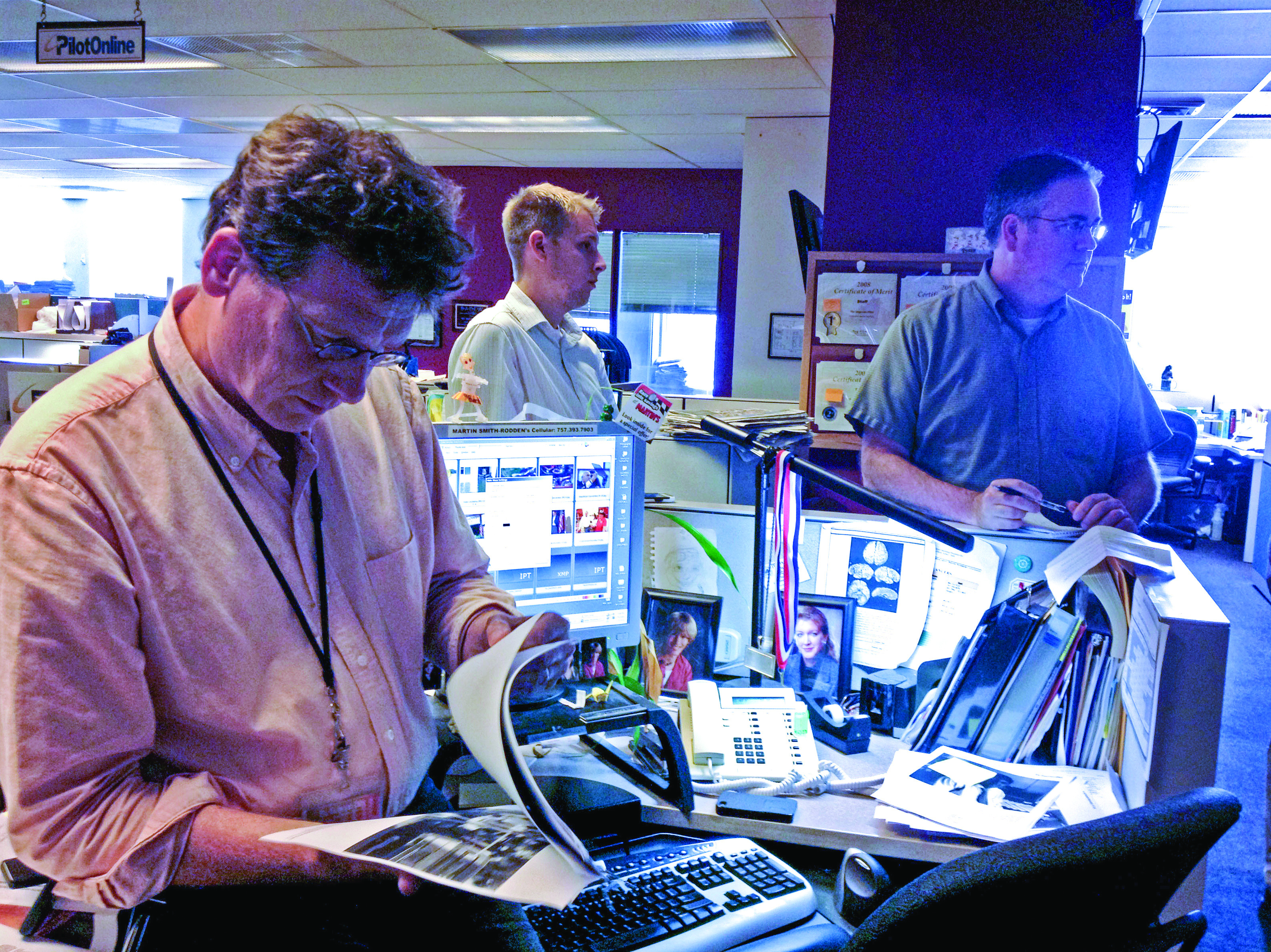
Dr. Martin Smith-Rodden, an associate teaching professor in the School of Journalism and Strategic Communication at Ball State University, has worked in the field of media since 1980. He has worked in many different locations throughout his career, including 29 years at The Virginian-Pilot newspaper.
Martin worked at The Pilot until 2015 as a photographer, including the last decade there as a photo editor. Martin explained that those last 10 years were also the time when the organization was moving from a “traditional print newspaper paradigm to a digital-first paradigm.”
Martin said the organization was geared predominantly toward online news, stating that they put out the physical newspaper “almost as an afterthought.”
The switch from print media to digital was very gradual, he recounted. There was no big “lightbulb moment” when he realized that times were changing, but he did notice the differences.
“When these changes happen, it tends not to be instantaneous. It might feel instantaneous when we look back on it, and we give it really cute names like ‘The Digital Revolution,’” Martin said.
Martin stated that his organization “certainly talked about the pace of change.” He added that within an organization, those sorts of changes spark lots of internal conversations, both formal and informal.
Other issues came with a switching paradigm, as well. Martin explained that his particular news organization had two different subdivisions, one exclusively concentrated on the print product and the other exclusively concentrated on the online product.
“Being a business and being a bureaucracy, those two silos did not talk to each other very well,” he said. “They were almost in competition, which sometimes happens, and that was an area of dysfunction that was sustained for several years.”
Martin noted that he was open to the evolving modes of media, while some others around him weren’t quite as keen.
“I’ve never been someone to be hung up on change, but there’s a lot to like about print, with the elements and opportunities for design and presentation,” Martin said. “It is natural for humans to be nostalgic for the technology and workflows that they learned during their formative years.”
The switch from print media to digital caused strong feelings across the media landscape, but evidently, not all were negative.
Keith Roysdon, a journalist of almost 50 years, published his first article as a high school student in 1977 and began work for the Muncie Star Press fresh out of high school. He then later went on to work for the Knoxville Sentinel newspaper. Keith said that throughout his time working in media, the transition from print journalism to online publishing was “probably the biggest change in any of our lifetimes” when it came to modes of communication.
Even though Keith’s beginnings were founded in print, he prefers the practicality of digital publishing.
“There are people who think we should have never gone online and miss the days of print so much. I understand that, but you can’t look back; you need to move forward,” Keith said. “You need to give people what they want, and there has never been a greater demand for news and information than there is now.”
As both Martin and Keith said, print media isn’t necessarily used in day-to-day life anymore, now finding its place and purpose in history.
Lindsey Vesperry, digital and physical records archivist in the Bracken Library Archives and Special Collections department, said digital pieces aren’t always easy to recover.
“I think people always kind of have the assumption that digital will last longer, and that is actually not true,” Lindsey said. “The web and born-digital media are a lot more ephemeral than we realize.”
On paper, as explained by Lindsey, it may seem like, since the internet is so all-encompassing, it would be easy to find just about anything. However, finding the content isn’t the issue.
“We could, for example, get a donation from someone who might have made a Microsoft Word document in the 1980s,” she said. “There might be a chance we can’t even open that document anymore because new versions of Microsoft Word can’t recognize it.”
Lindsey said media that is only published online with no physical content is harder to archive. Print media offers a unique preservability that something intangible does not. She added that preservation has become more difficult as manuscripts are made with less care, as technological developments like the printing press increased production rates.
She explained that up until the industrial era, literacy rates were very low. People who could read were the clergy or aristocracy, so books at the time were also very expensive. The work was considered difficult, as all the pages had to be done by hand, by scribes.
Lindsey explained that the mold was broken with the Industrial Revolution and the creation of paper. Paper was a lot cheaper than the materials previously used, but the automation of paper creation also helped. This was not without drawbacks, though.
“The automation made things that were not really meant to last,” said Lindsey. “With newspapers, you read it for a day and you toss it out.”
As explained by Lindsey, the short lifespan of newspapers is very characteristic of an ever-changing world, as there are always new stories to be told. There is charm to creating a newspaper in a rush, and it’s something adored by many journalists.
Keith explained that he understands the appeal of a newsroom rush. He recounted a pre-digital age plane crash in Muncie, and used his experience of covering that event as an example for a news race.
“We had to get there fast. But we also had to be fast in doing a couple of quick interviews,” he said. “At the time, we had to get on the phone back to somebody in the newsroom, and they would start adding to the story.”
Keith explained that this process was necessary in order to get an article done by the end of the day. He also added that a side effect of the changed times is that deadlines are earlier now than they were “back then” because papers are printed further away.
There are pros and cons to printed media and digital media alike, and as times evolve, a common concern is that print news will cease to exist entirely. However, Lindsey said, humans are more adaptable than we’re credited for.
Lindsey explained that news, just like everything else, evolves with the times, and she is optimistic for the future.
“I understand cutting print news, practically speaking. I think it might be a bit harder [in a sense of archiving],” said Lindsey. “But I will say I have a lot of faith in how students and young people can evolve to understand the new concepts around them.”
This article is a part of Ball Bearings Fall 2025 magazine: The Archival Edition. Read more stories online at ballbearingsmag.com and pick up the print edition of the magazine across Ball State’s campus now.