Revitalizing The Village has been a large construction focus of Ball State University. With seven different projects scheduled to be worked on until 2028, according to Ball State University, the campus landscape is steadily changing. But over its century of existence, the school has consistently built buildings, torn them down and repurposed them.
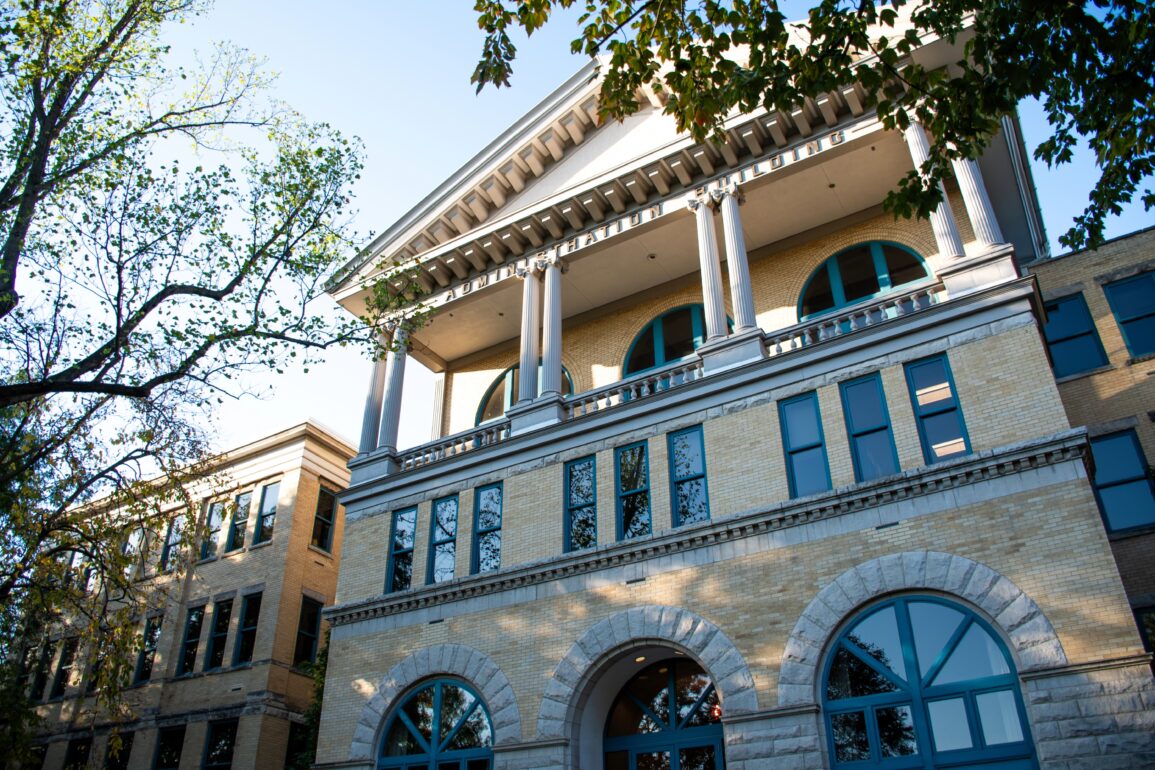
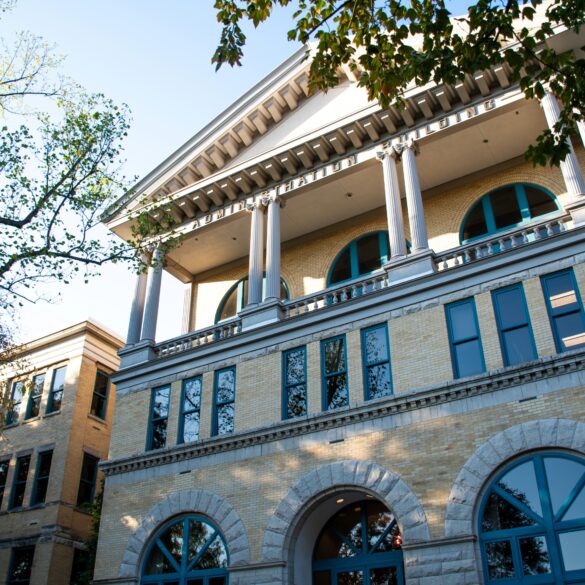
The light yellow bricks and blue accents to the administration building in The Quad stand out compared to the rest of Ball State’s heavily red-brick campus. Finished in 1899, the building opened to house the Eastern Indiana Normal University. At its opening, it offered sixteen different departments with a tuition of $10 per 10-week term, according to a 1899 pamphlet issued by Eastern Indiana Normal University.
At the time of its opening, the building was praised as an “architectural triumph,” according to a 1968 Ball State News, now the daily news article. Inside the new establishment, classrooms were found on the first floor, equipped with chalkboards and furniture. Each section of the building had a designated academic department and faculty offices.
From its opening in 1899, the institution had gone through five name changes and a brief closing between 1907 and 1912, when it became the Muncie Normal Institute. A year later, it was renamed to the Muncie National Institute until 191,7 when debt forced it to close, according to Ball State University Libraries. The site was purchased by the Ball brothers later that year and given to the state, marking the beginning of Ball State in 1918.
From the 1920s and 30s, multiple other academic buildings were completed and opened for the university. The Burkhardt building was completed in 1924 as the “science hall,” while the original campus library was finished in 1926, which is now known as the North Quad building.
While renovations were being done on the administration building in 1964, the school used two houses that they had purchased as temporary office spaces.
Near the administration building is Lucina Hall, which houses nine different campus offices and departments, with the building acting as a Welcome Center. The building is the first place prospective students visit, and is one of the oldest buildings on campus.
Construction was finished on Lucina Hall in 1927, originally a women’s dormitory for the Ball State Teachers College. It was built to house 110 girls and included a dining hall, which was later relocated to behind Elliott Hall upon its opening.
The building is named after Lucina A. Ball, the oldest sister of the Ball family. Lucina started working as a teacher and eventually became the first secretary of Drexel Institute in Philadelphia, according to Minnetrista Museum and Gardens. Next to the women’s hall was Ball State’s first residence hall, Forest Hall, which was torn down to make additions of 100 rooms to Lucina Hall in 1941.
During the 1973-74 academic year, the interior of the building was converted from a residence hall to an office building. Twenty years later, another round of renovations was completed. During these changes, the admissions office was relocated from the administration building to Lucina, where it currently resides.
Andrea Sadler, an associate director for the Office of Undergraduate Admissions, spends her days working in the historic building. For her, welcoming future students in the former residence hall is special.
“Prospective students are starting their journey where Ball State started [its] journey,” Andrea said. “It’s just a very connected moment.”
Andrea and the Welcome Center staff value the historical space and hope to maintain it in the best shape they can.
“We’re constantly straightening the lobby. We’re constantly making sure the restrooms are cleaned,” Andrea explained. “… I feel like we’re the caretakers of the history that’s in this building.”
Faith du Toit, the Welcome Center and group visit coordinator, works closely with Andrea and shares the same passion for the building.
“Just seeing the history and how far we’ve come, that’s kind of a motivator for us,” Faith said. “This is where we came from, we’re the start of campus, but then also the start of a lot of these families’ journeys that they’re starting as well.”
Andrea and Faith both agreed that students’ connection with Lucina does not end after admission but continues through the other services provided in the building.
Two years before Lucina was completed, Ball Gymnasium was the newest building on campus, with construction finishing in 1925. The gym was a gift from the Ball family, which resulted in the university’s name being changed to Ball Teachers College, Eastern Division, Indiana State Normal School in 1922, according to Ball State University Libraries.
One hundred years after the gymnasium complex was completed, it is no longer Ball State’s main arena. In the 1960s, Irving Gymnasium was finished, taking Ball Gymnasium’s spot for home athletics events. The school continued to update its athletic facilities, completing Worthen Arena 30 years after Irving’s opening. Currently, it serves as Ball State’s official sports arena with a capacity of 11,500 fans, according to Ball State University.
Irving Gym became part of the Jo-Ann Gora Recreation Center, which was completed in 2010.
Just outside The Quad is Burris Laboratory School. The K-12 school was established in 1929 as a part of Ball State Teachers College. Home games for Burris’ basketball and volleyball teams are currently played at Ball Gym. The facilities are still used for some Ball State physical education classes and are open to students for recreation activities.
In December 1964, ground was broken for an $11 million housing project, LaFollette Complex. It was expected to be done in three years and accommodates nearly 2,000 students. A year before its completion, a fire broke out during construction due to a gas line leakage, according to a 1966 Muncie Evening Press article. Despite this setback, construction on the hall continued to prepare it for opening.
The 10-story building included housing for undergrad and graduate students, kitchenettes, lounges and laundry rooms on each floor, with an accompanying dining hall. Women’s and men’s halls and lounges were separate, as well as separate housing for graduate students when it opened.
Eventually, the area surrounding the complex blossomed with the addition of the Johnson Complex and Carmichael Hall. In the decades that followed LaFollette’s opening, it stayed open and housed thousands of students, but eventually aged as central air became more standard and other dorms on campus received renovations. Instead of renovating the 50-year-old building, the university decided to start over completely with new residence halls.
In the dorm’s 50 years of being open, many Ball State alumni have memories living there, being with friends, or the dining services of the building. Becky Nickoli lived in Woody Hall in the LaFollette Complex in 1966. Because the rest of the building was still being finished at that time, only Woody and Shales’ floors were open in LaFollette that year. Even though they opened the floors to students, Becky remembers seeing the finishing touches being made during move-in.
“There were people actively working and still things along the hallway, like doorknobs and showerheads and shower curtains in the bathrooms,” Becky said.
For a couple of days, she had a hole in the wall where a phone would eventually be placed to go back and forth between her room and the one next to her.
“If the people in the next room were still up, but you wanted to go to bed, the light from their room would shine right into your room,” she explained. “You had to, like, stuff a towel or something in the hole to keep the noise and the lights out.”
While the student living spaces were quickly completed soon after move-in, the rest of the building, including dining and lounges, would not be finished. The only dining option for Becky was at Noyer Complex, across campus. It wasn’t until homecoming weekend that she was able to see the hall fully finished and ready for guests.
While her family was visiting in the newly completed lounge, the repercussions of the complex being under construction became clear to her and her family.
“I remember that my dad saw a mouse run across the floor in the lounge,” she recalled. “It was just kind of funny. He’s like, ‘What did I just see?’”
After her first year in the complex, Becky was assigned to the dorm again the next year. During this time, she was able to utilize the amenities that weren’t open the year prior, such as the dining services in the building. During LaFollette’s years, not only did Becky herself live there, but her son and grandson were able to experience the complex as well.
In 2017, demolition began on parts of the LaFollette complex, which would continue until the last pieces were razed in 2022. This decision was made as part of a plan that included the new residence halls, North West and Beyerl residence halls, and North Dining. North West was built to replace Carmichael Hall, and North Dining would become a replacement for LaFollette’s services.
Despite its destruction, the building is not completely gone. The LaFollette Brick Project was created to give former residents a piece of their history and raise money for the Thelma Miller Scholarship fund. It allowed people to buy a brick from the building for $75. Not only have some bricks found new homes, but limestone from the dorm was repurposed to create the pillars of its memorial.
Ball State continues to make changes to campus, reviving older spaces and creating new ones. Even with the addition of new buildings or renovations on older ones, the history of and experiences of students still remain. As the university works on The Village, current students will keep the memory of how the area looked during their time. The memories, photos and stories keep the older spaces of campus alive.
This article is a part of Ball Bearings Fall 2025 magazine: The Archival Edition. Read more stories online at ballbearingsmag.com and pick up the print edition of the magazine across Ball State’s campus now.