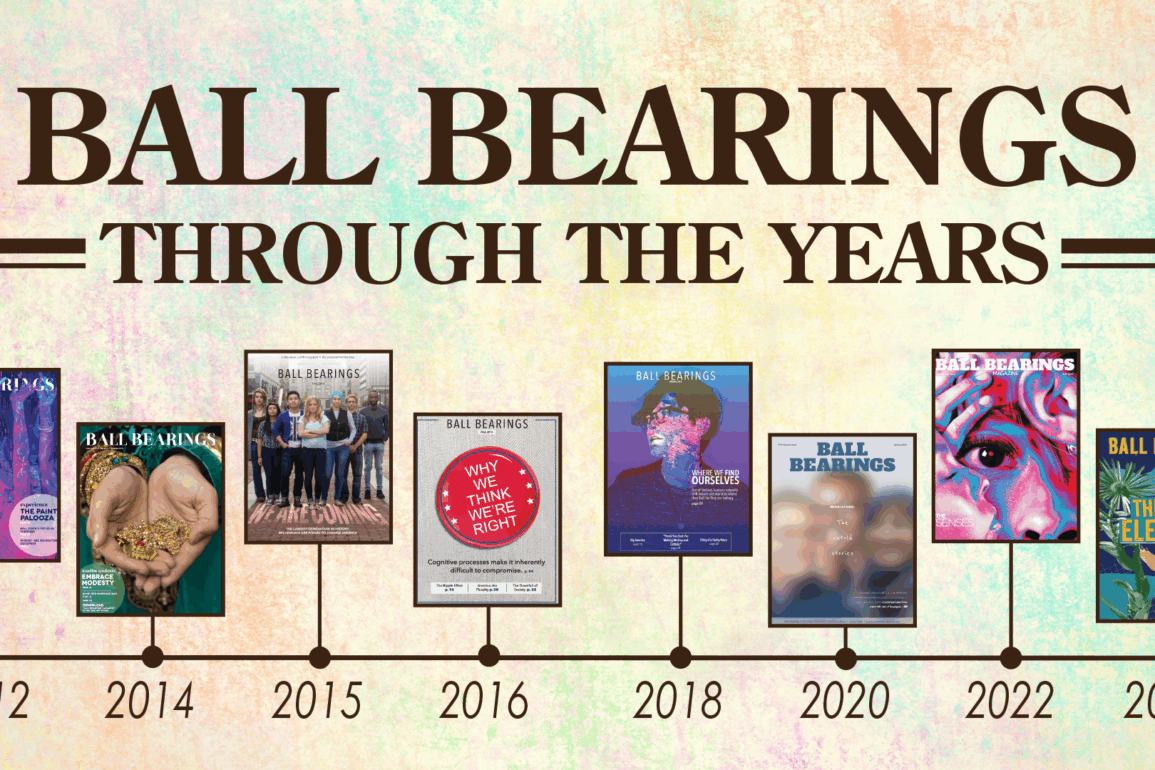
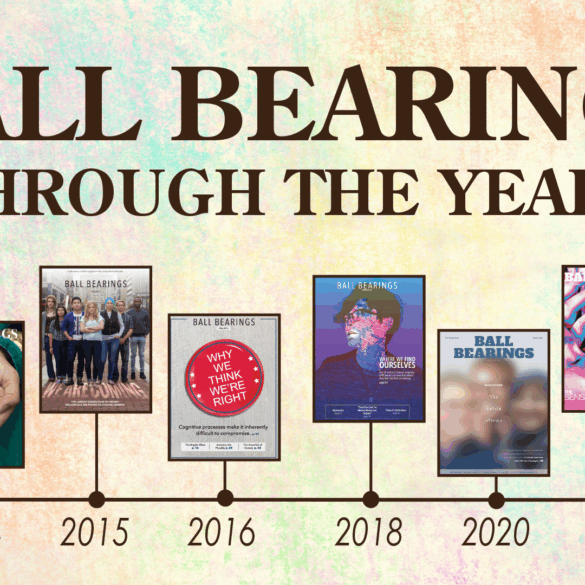
In 1976, “Verbatim” was published as the first student-run magazine at Ball State University. The name would eventually change to “Expo” a decade later, but it wouldn’t be until 2006 that Ball Bearings would start as an online magazine, with “Expo” merging into the new publication, according to Ball State University’s School of Journalism and Strategic Communication.
Since the beginning of Ball Bearings, it has published a range of stories. However, it wasn’t very well-known until Miranda Carney took leadership in the fall semester of 2015 as editor-in-chief, alongside her Executive Editor, Kaitlyn Arford.
“A lot of what I did that senior year was educating people about our magazine. Both in terms of ‘Hey, this [magazine] is pretty cool,’ and also, ‘Hey, you should get involved, because we really need your help,’” Kaitlyn said.
Kaitlyn said the previous process had been really unorganized, describing it as “disjointed in vision.” She said it hadn’t seemed like anyone had the necessary resources or oversight they needed for success.
Alex Kincaid, the Editor-in-Chief for the following school year, said sticking to specific themes had not been as huge a “local interest.” With the magazine’s revamp, they hoped to focus on national issues.
Miranda said they intended to overhaul the process. She had a specific vision for Ball Bearings, stating that if anyone across the country were to pick up this magazine, “they should be interested in it, whether or not they know what Ball State is.”
For the Fall 2015 edition, the theme was Millennials. Executives wanted to expand from Ball State’s campus, still hoping to highlight relatable stories for both an on- and off-campus audience. At the time, millennials were the next generation heading into the workforce, according to Miranda.
“Obviously, we don’t want to leave the community out of it completely,” Miranda said. “It was just less reporting on college trends and more ‘Here’s the bigger national trend and here it is through the lens of Ball State students and [Muncie’s community].’”
Ball Bearings’ members worked on several stories for that semester, as they produced weekly digital stories alongside the printed magazine. Digital themes would often branch into smaller topics beneath the theme of Millennials, touching on topics like sexuality, gender, finance, and education.
As the digital themes kept evolving, Miranda wanted to prioritize the theme of Millennials. Members began changing the magazine’s process, introducing new concepts of magazine production and design into the edition.
“We developed a ‘front of book’ section,” Kaitlyn explained, as one of the examples. “Some of our younger journalism members could do a lot more reporting, and then the features went to more upperclassmen.”
For the following semester, the theme was “Our Money, Their Secrets.” This theme focused on college spending, taking a deeper dive into select programs benefiting from students’ tuition. Kaitlyn recalls researching Ball State’s mental health facilities and finding financial struggles. The department hadn’t been doing as well as the athletic program, an effect mirrored by several other programs.
“We knew that ‘Our Money’ was going to be the biggest edition,” Kaitlyn said. “That’s the one we want[ed] to win awards. We want[ed] it to be ironclad. We want[ed] to know all the details.”
Despite the magazine’s broader stories during the previous semester, Ball Bearings’s executive team decided they needed to intensify the magazine’s audience on campus. They had to gain students’ interest in reading the magazine.
For the first time, Miranda and Kaitlyn worked together to produce something unique.
Ball State’s president had stepped down at the time, which shifted the discussion from university spending to finding a new president. Using this topic, they set up a Q&A with the interim president of Ball State in front of a live audience.
“For me, it was culminating,” Miranda said. “That was a big area of growth for me, because I never would have imagined that I would have done something like that.”
Brad King, Ball Bearings’ advisor at the time, recommended the idea. It was something that national magazines did regularly, and there wasn’t any reason Ball Bearings couldn’t do it, Kaitlyn said.
Brad had just started working as Ball Bearings’ advisor when Kaitlyn and Miranda took control, having experience in teaching long-form journalism and even writing for WIRED, a well-known online magazine focused on technology, business, science and culture.
He no longer works at Ball State, but Miranda and Kaitlyn would often go to Brad for suggestions and advice for magazine production.
“He worked really hard with us,” Kaitlyn said. “For us to understand exactly what we needed to do.”
Alex Kincaid took over as editor-in-chief the following semester in 2016. With this change in leadership, direction fell toward a national topic: political division.
This edition was inspired by the upcoming 2016 presidential election, something executives felt was being discussed across campus. This issue was known as “Why We Think We’re Right.”
“Our entire time focused on this newfound division that the country was seeing with the campaigning for the election,” Alex said.
The semester’s stories focused on a range of political topics, even looking into the cognitive processes and reasoning for the reported division within the country.
“I would say the biggest transformation happened with the transition to [Miranda and Kaitlyn],” Alex said. “We had a new advisor, and he really helped us take [Ball Bearings], which was always more of a local interest, and mirror what a national magazine would look like; localizing [a national theme] to [our] audience.”
She explained that they carried on with the process that the previous executive team had put into place.
“I wish we had that structure in place before my senior year,” Kaitlyn said. “Looking back, I think I would have benefited as an undergrad to have that opportunity to do some of the reporting Ball Bearings was doing at a young age.”
Similar to the live-audience event that Ball Bearings hosted for “Our Money, Their Secrets,” the fall’s political issue advertised the magazine through a panel discussion about civility and politics. With around one hundred people attending this panel, Alex explained that they drew people to this event for the political discussion. They took that chance to advertise Ball Bearings, as everyone left with their own physical copy of the magazine.
Soon after, changes in technology began impacting the magazine. The Spring 2017 issue was titled “Our Digital Destiny,” which looked into the impact of social media. Staff even reported on AI, a topic people didn’t know much about at the time.
“It’s kind of interesting that more than about ten years ago, we were looking toward that, and now we’re kind of living it,” Alex said, discussing their story that looked into when artificial intelligence would cross the threshold into becoming human.
Currently, Ball Bearings magazine continues to focus on stories that can direct national trends towards a local audience. Fall 2024, the Civil Issue touched on community homelessness, addiction and more. Spring 2025, the Elemental Edition covered topics like food insecurity and recycling in Muncie.
According to Ball State University’s School of Journalism and Strategic Communication, the online versions of Ball Bearings have won National Pacemaker Awards from the Associated Collegiate Press in 2012, 2016, 2017, 2018, 2020 and 2024.
The Ball Bearings website archives published content dating back to Sept. 2009, and will continue to serve as Ball State’s student-run magazine for news, trends, features, photo essays and more.
This article is a part of Ball Bearings Fall 2025 magazine: The Archival Edition. Read more stories online at ballbearingsmag.com and pick up the print edition of the magazine across Ball State’s campus now.