Jake Dickman is a third-year journalism major and is a guest writer for Ball Bearings Magazine. His views do not necessarily reflect those of the magazine.
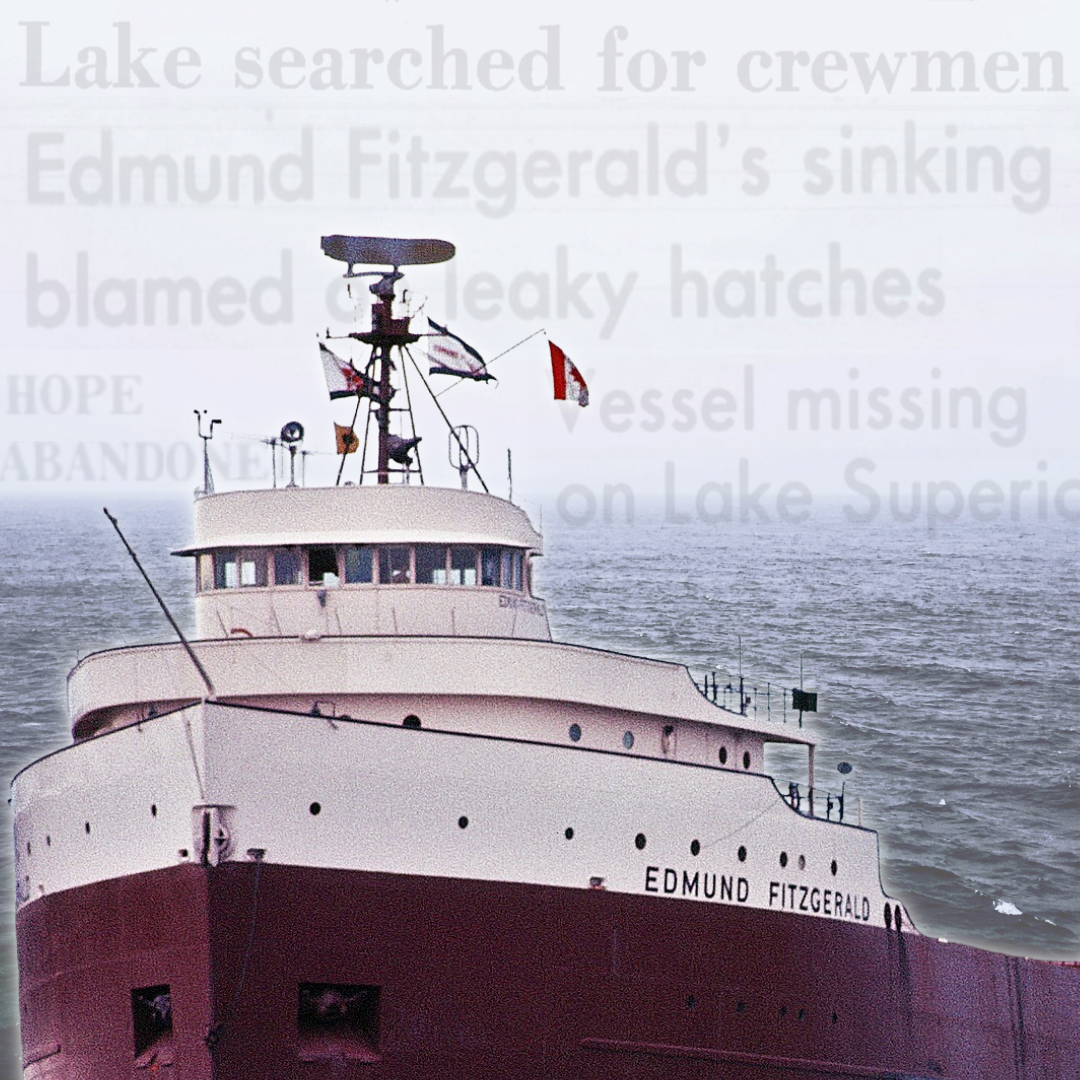
Just after 2 p.m. on a fall Sunday in 1975, a 729-foot freighter named “SS Edmund Fitzgerald” departed from Superior, Wisconsin, carrying over 26,000 tons of taconite ore. The ship, affectionately named “Big Fitz,” was heading for Zug Island in Detroit. But the next evening, the ship would vanish, never reaching her destination.
Just some 17 miles from Whitefish Bay, Michigan, a distance Edmund Fitzgerald could cover in just over an hour, the Great Lakes freighter met her demise. It wasn’t some well-documented sinking like the RMS Titanic; Edmund Fitzgerald’s sinking story was quite the opposite.
The Fitz had been traveling with a sister ship called SS Arthur M. Anderson when a storm bringing sustained winds of nearly 70 mph hit the duo. Snow began to fall, and Arthur M. Anderson lost sight of Edmund Fitzgerald shortly thereafter.
It would prove to be the last time they would see her.
Captain of the Fitzgerald, Ernest McSorely, radioed Anderson less than an hour later, stating that he was taking on water and had begun to develop a list, meaning she was leaning heavily to one side. McSorely radioed a second time, reporting a failing radar. In the midst of a snow squall carrying near hurricane-force winds, Big Fitz was sailing blind.
Captain of the Anderson, Jessie “Bernie” Cooper, did all he could to lead Fitz to Whitefish Bay, but as the snow grew stronger, her radar was whited out, meaning all contact with Fitzgerald would be via radio.
As the afternoon turned to night, Anderson would find herself nearing Fitzgerald. Cooper radioed ahead to her sister, asking how they were doing. McSorely reassured Anderson that everything was okay, responding with a simple message.
“We are holding our own.”
These five words would be the final message ever received from Fitzgerald, as ten minutes later, she became entirely unreachable. Unbeknownst to Anderson, the 729-footer was on the bottom of Lake Superior, broken apart into two.
It’s believed she sank in under a minute because no distress signal was ever sent.
How she sank remains a mystery to this day. Some conspiracies think she broke apart on the surface, while others believe it was three rogue waves that sent her into a nosedive to the lakebed. No matter what happened, only one thing is certain.
All 29 souls aboard were lost.
SS Edmund Fitzgerald’s story serves as a stark reminder that we are nothing to stop the forces of Mother Nature. It is a story that was immortalized in an unusual way.
Less than a month after the sinking of SS Edmund Fitzgerald, Canadian singer Gordon Lightfoot read an article in Newsweek titled “The Cruelest Month.” The article details the night of Nov. 10, 1975, when the lives of the ship’s crew were lost. Moved by the story of SS Edmund Fitzgerald, Lightfoot decided to write a song, drawing from the details of the Newsweek article.
Originally, Lightfoot was hesitant to release the song, fearing that the music would bring up claims of exploitation of a tragedy. However, in August of 1976, Lightfoot chose to include the track on his album “Summertime Dream.” The track came to be known as “The Wreck of the Edmund Fitzgerald.” To this day, it remains his most successful song, charting at No. 1 in his native country, Canada.
But now I ask, so what? Who cares about this 50-year-old power ballad about an American ship sinking in Lake Superior, written by a Canadian singer before all the details even emerged?
Me, I care. And I’m not alone.
Despite the fact that I was born March 11th, 2005 — 30 years after Fitz met her untimely demise — I, along with a vast majority of inhabitants of the Midwestern United States, care about the story behind “The Wreck of the Edmund Fitzgerald.”
Beginning with the rarity of the wreck, it’s not something you hear about every day, especially in the Midwest. Today, there are an estimated 3 million different shipwrecks that are scattered across the oceans, according to research done by UNESCO.
That’s off the coast, though, not right in a Midwesterner’s backyard.
If you were to tell someone from Boston that a ship sank off the coast of Nantucket 50 years ago, they might care, but they would eventually move on and pay it no mind. Eventually, it would get old and that care would disappear.
In a landlocked state, however, there would most likely be a much different reaction. If you tell someone from rural Indiana that a ship sank some 17 miles from land in the middle of Lake Superior, and a Canadian singer decided he wanted to make a song about it, I can almost guarantee that you would get a much different reaction than the one from the Bostonian.
I like to compare it to a law in Nebraska that ruled hunting whales within state boundaries illegal. If someone were to successfully hunt a whale within the state lines of Nebraska, it would live on in history because it’s remarkable and essentially impossible.
A ship sinking in the Great Lakes may not carry the same level of difficulty that hunting a whale in Nebraska might, but for a subsequent song to top the charts in several major countries around the world is a nice nod to the Midwest.
The next appeal of this story is the mystery. Of course, the wreck of SS Edmund Fitzgerald is a tragedy. I’m not trying to make it seem like a talking dog and his friends are attempting to solve the mystery of how it sank — this isn’t Scooby-Doo.
Twenty-nine lives were lost that night when the ship split in two at some point: That’s all we know. We don’t have any other information about the wreck itself. Did the ship break apart on the surface or after it hit the bottom of Lake Superior? How quickly did the ship sink? Why wasn’t a distress signal ever sent out? These are all questions we’ll probably never have the answers to.
Of course, there are the so-called “experts” out there who believe they know exactly what happened that night. They’ll tell you all kinds of stories about how Fitz sank and why you should believe them over anyone else. But the truth is, only 30 people know what happened that night: the 29 crew members and God. Unfortunately for us, none of them can speak to the events that led to the ship’s sinking that November night. It needs to stay that way. Without the element of mystery, one of the pillars on which this shipwreck stands will collapse.
Despite these resident experts, the opportunity to get answers has most likely closed. Due to the cold freshwater of Lake Superior, the wreck of SS Edmund Fitzgerald remains almost completely intact with no bacteria or rust to eat away at her. There have been a few expeditions to gather answers about how she went down, but none have been conducted in the last 30 years. This is because the Canadian government now guards the site as it is considered a mass grave and tampering with such is a criminal act.
There have been numerous requests throughout the years to try to gather evidence as to how she went down, but all have been denied. It’s a mass grave site, and we need to respect it as such, especially for the families who lost a son, husband, or even dad in the wreck.
Nothing quite like that unique sinking has happened since 1975. After the loss of Fitz, sweeping regulation changes in maritime trade on the Great Lakes took effect. In order to stop massive ships like Big Fitz from sinking, the United States Coast Guard created stricter regulations aimed at making ship trade safer.
Unsurprisingly, it worked, as since that fateful night in 1975, there has not been another commercial shipwreck on the Great Lakes resulting in the death of the crew. While it isn’t impossible for a cargo vessel to sink in the Great Lakes, it is highly improbable because of what was learned from SS Edmund Fitzgerald’s sinking, making this famous lost ship’s legacy undeniable.
In a way, the wreck transcends pop culture, becoming a sort of political and regulatory reminder that rules can save lives.
The sheer magnitude of SS Edmund Fitzgerald’s final voyage is one that can not be understated. The afternoon of Nov. 9, 1975, saw 29 men, aged between 20 and 63 years old, launch from a port in Wisconsin. Those men were doing their job just like any one of you and I; just like they had done for 17 years prior to the sinking.
We use Lightfoot’s song as a reminder of those 29 souls that were lost in Lake Superior on Nov. 10, 1975. Their legacy lives on, immortalized in a power ballad about their final voyage. The memory is carried on in other ways, as the Mariner’s Church of Detroit rings its bell 29 times every Sunday closest to November 10 for each life lost. But none carry the weight and prowess of Lightfoot’s tune.
So while I may be a kid from Northern Kentucky, I hold “The Wreck of the Edmund Fitzgerald” dear to my heart. It could be false nostalgia, or maybe I’m being cynical. Or, better yet, maybe the words and soundwaves of Gordon Lightfoot’s voice stand upon the pillars above, reminding us every year of those brave men who allowed for a safer today by giving up their lives.
This article is a part of Ball Bearings Spring 2026 magazine: Waves. Read more stories online at ballbearingsmag. com.